JOURNAL
Why Hidden Imagery Makes a Painting Feel Alive
A hidden image changes the past of a painting. Once you see it, it feels as if it had always been waiting there.
Best entered slowly. Look for gestalt figures and for the places where the image seems to shift after the first glance. The meaning is not fixed; it gathers itself through attention.
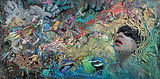
Why Hidden Imagery Makes a Painting Feel Alive begins with a simple refusal: the hidden image will not remain flat, silent, or decorative. In Megan Ashman’s visual language, faces in texture, animals formed by chance, eyes embedded in shadow, hands appearing from fragments, and larger figures visible only from a distance gather into a world that behaves according to dream logic rather than ordinary sequence. The work is not asking to be decoded once and dismissed; it asks to be entered slowly, as if every layer were a room and every fragment were a door left slightly open.
At the center of this idea is the belief that hidden imagery creates the sensation that the painting possesses an inner life beyond immediate perception. A painting can hold what language cannot carry cleanly: contradiction, memory, spiritual weather, grief, beauty, and the strange intelligence of images that arrive before explanation. This is where the article belongs in the gallery’s symbolic archive—not as a definition that closes the subject, but as a threshold into it.
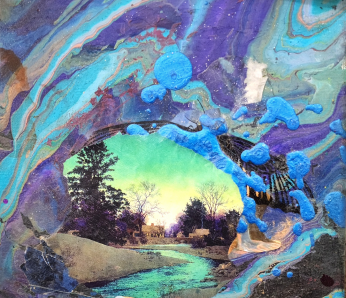
The first encounter is physical. The viewer meets faces in texture, animals formed by chance, eyes embedded in shadow, hands appearing from fragments, and larger figures visible only from a distance, but also the evidence of making itself: paint poured, paper torn, pigments suspended, texture raised into terrain, objects chosen because they carried a charge the image needed. Mixed media matters here because the materials refuse to behave like neutral tools. They arrive with histories, weights, surfaces, and private associations.
A scrap of paper can become a relic. A bead can behave like a planet, a button like a sealed chamber, a chain like both bondage and connection. Mica catches light the way memory catches suddenly on an ordinary day. Ink blooms into atmosphere; collage interrupts the painted field with fragments of another reality. The surface becomes archaeology—not illustration, but excavation.
This is why General; Psychedelic & Surreal and Hands & Eyes; Surreal are useful maps, but never the whole territory. Collections can organize the work, but the work itself keeps slipping past categories. It wants to be felt first, then thought through. It wants the viewer to notice what appears, disappears, and returns with a different meaning.
The second image was there all along, but it needed another way of seeing to arrive.
Beneath the visible surface, the hidden image begins speaking in symbols: gestalt figures, sideways seeing, subconscious arrangement, multiple readings, and the viewer's mind completing patterns from fragments. These images open into perception, pareidolia, apophenia, dream logic, collaboration between viewer and artwork, and the thrill of discovery. They are not symbols in the simple sense, not signs with one clean translation waiting underneath. They are more like weather systems—moving, layered, sometimes contradictory, truer because they refuse to become singular.
This is where the work touches the philosophical spine of Ashman’s practice. Reality is not treated as a fixed wall but as a permeable membrane. The subconscious is not a storage room for forgotten things; it is an active landscape, a place with its own physics, its own creatures, its own forms of memory. What looks accidental may become inevitable after enough looking. What looks decorative may begin to behave like a message.
The deeper truth is this: looking is not passive; the viewer helps the painting become visible. That truth does not need to be resolved to be powerful. In fact, the unresolved quality is part of the force. The painting breathes in paradox: hidden and revealed, wounded and luminous, physical and spiritual, intimate and cosmic. It does not choose one side. It holds both until they begin to vibrate.
The process behind this kind of work is not purely planned, and that matters. Ashman’s practice leaves room for chance, surrender, and what she describes as creative energy moving through and beyond the conscious self. A fragment may fall into place. An image may emerge from another angle. A face, animal, or figure may appear from a distance with such certainty that it feels less invented than discovered.
That moment—when the hidden image reveals itself—is central to the experience of the work. It is a gestalt event, the instant the whole becomes more than the sum of its parts. The viewer sees a shape, then a presence, then a story; and once seen, it cannot be unseen. The painting has changed, but so has the viewer’s memory of looking at it.
This makes the artwork feel alive. Not alive as metaphor alone, but alive in the way it continues to act upon perception. It remembers. It withholds. It discloses. It changes under different light, from different distances, in different states of mind. The viewer does not consume the image; the viewer enters into relation with it.
Why Hidden Imagery Makes a Painting Feel Alive is ultimately an invitation to practice a more patient form of seeing. Not the quick glance of consumption, but the slower gaze of recognition. The kind of looking that allows ambiguity to remain alive, that lets questions stay open, that understands beauty as something stranger and more demanding than decoration.
Hidden imagery makes a painting feel alive because it refuses to be exhausted. It keeps becoming, even after the first look has ended. The article, like the painting, should leave a door open. Not everything needs to be explained. Some meanings are stronger when they remain partially veiled, waiting for the viewer to step closer, look sideways, and find their own way through.