


ORIGINAL MIXED-MEDIA ARTWORK
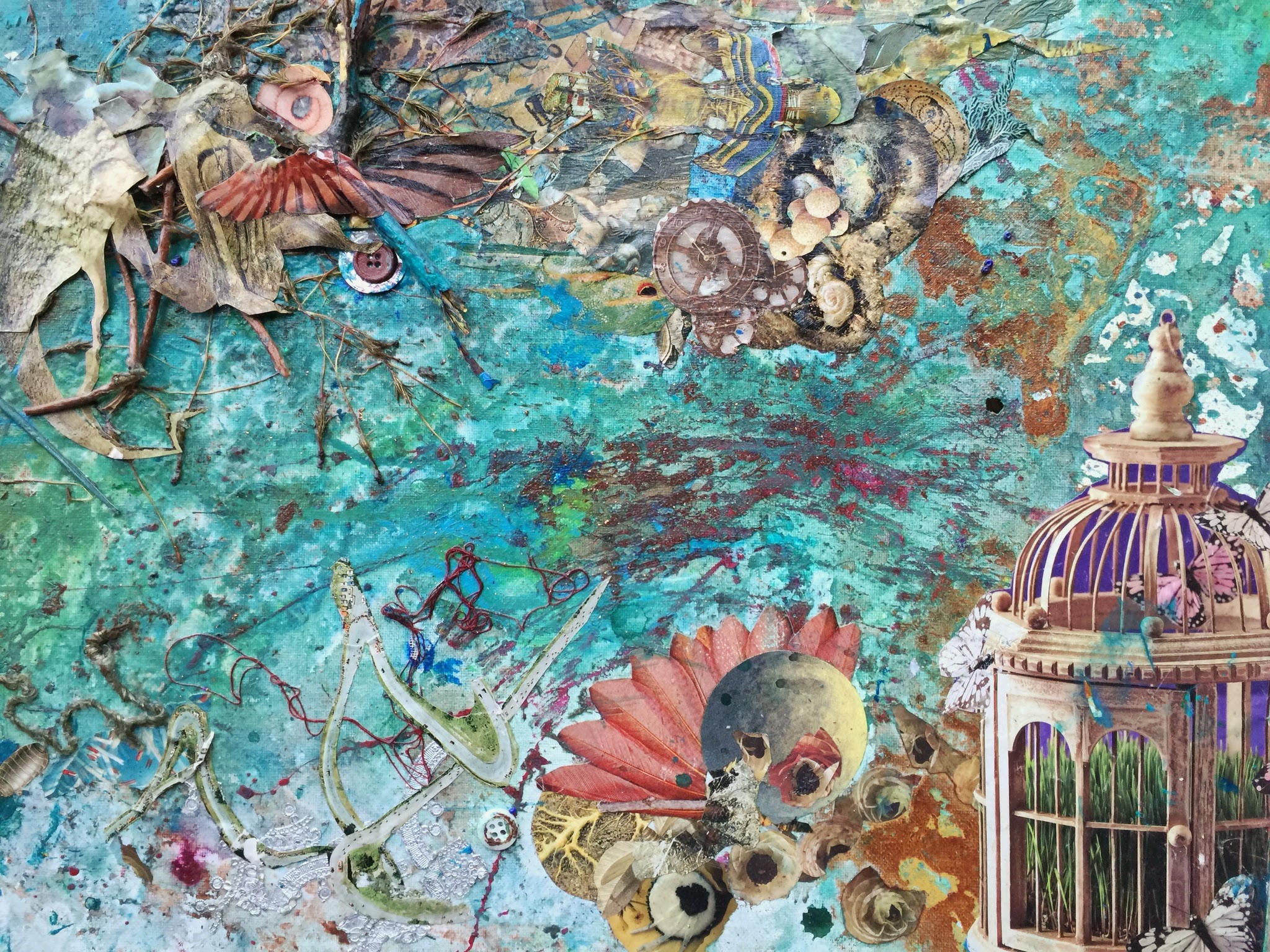
Flightless Bird
Megan Ashman
PUBLISHED
SIZE
14x18
MEDIUM
Mixed media on canvas
COLLECTION
Animals & Insects;Elements & Seasons;Nature
SUBCOLLECTION
Air;Animals;Flowers;Spring
Price
View purchase options below to buy original or prints
Purchase Options
✦
Secure Checkout
✦
Certificate of Authenticity
✦
Carefully Packaged
✦
Direct Studio Support
ABOUT THE WORK
01 Description
This painting knows the weight of clipped wings, the particular grief of bones that remember sky. Across a turquoise expanse oxidized like ancient copper, skeletal remains arrange themselves into elegy—delicate avian architecture laid bare, stripped to the mathematics of what once lifted. On the left, a wing spreads in ghostly dimension, each feather preserved as though in museum display, beautiful in its uselessness. Buttons and gears scatter like fallen seeds, the machinery of earthbound existence. A birdcage stands intact on the right, ornate and golden, its arched windows framing not emptiness but grass—green blades growing where a bird should perch, nature reclaiming what confinement built. Near center, a skull rests among coral petals, death adorned, the small tragedy made ceremonial. The oxidized surface blooms with rust and verdigris, time's patient language writing across every. Ribbons of calligraphic marks trail through the composition like flight paths remembered by muscles that can no longer execute them. This is the canvas's meditation on captivity and its aftermath—how some losses lodge so deep in bone that even death can't restore what was taken. The turquoise surrounds everything like water or sky, the element these creatures were denied, now claiming them completely. Clock parts mark time that no longer matters to the dead. The painting understands that flightlessness is not merely grounding but erasure of possibility, the slow fossilization of what might have been. It holds these remains tenderly, making beauty from the ruins of potential.
HOW IT WAS MADE
04 Materials & Process
mediums/materials: phosphorescent paints, found objects, paper, wax, photo collage, oxidative inks, distress paint and inks, acrylic pouring, digitally altered images, acrylic paint, watercolor, spray paint, walnut ink, staining mediums, tissue paper, mica powders, glitter, heavy gel medium, gesso, pebeo prism and fantasy paints, ceramic paint, stained glass paint, alcohol inks, iridescent inks, distress crayons, charcoal, pastels, oil pastels, string, beads, jewelry, gems, chains, buttons, foils, newspaper, vinyl, plastic, walnut inks, india ink, colorshift paints and more!
THE ARTIST'S VOICE
03 Interpretation
This work explores the particular devastation of potential thwarted—beings designed for flight rendered earthbound through captivity, injury, or circumstance. It addresses both literal and metaphorical flightlessness: the grounding of spirit, ambition, creativity, or selfhood by forces external or internal. The piece questions what remains when defining characteristics are stripped away—if a bird cannot fly, what is it? If we cannot become what we were meant to be, who are we? The collision of delicate avian anatomy with heavy oxidation and decay speaks to how captivity and denial corrode from within, how what cannot be expressed eventually turns inward and destroys. Yet the work also finds strange beauty in this destruction, suggesting that even in loss and limitation, there is something worth preserving, worth mourning, worth making art about. The grass growing in the cage offers ambiguous hope—nature persists, life finds ways to continue, but it may not be the life that was intended or desired. The archaeological presentation of remains asks viewers to witness, to study, to understand what was lost so that perhaps such losses might be prevented in future. This painting serves as both memorial and warning, honoring the specific while speaking to universal experiences of constraint, whether by others' hands or our own fears. It suggests that the worst prisons are those where the door eventually opens, but by then we've forgotten how to leave, or worse, our wings have atrophied beyond use. ```
WHAT LIVES INSIDE
02 Hidden Imagery
The birdcage represents multiple layers of meaning—literal captivity, the social cages we construct, the limitations imposed by others or circumstance, and perhaps most poignantly, the internalized prison that remains even after external barriers fall. The grass growing inside suggests nature's persistence, reclamation, and the irony that freedom arrived too late or in the wrong form. What grows in the space meant for flight is earthbound, rooted, the opposite of avian nature. The skeletal remains and preserved wings function as memento mori—reminders of mortality but also archaeological evidence of what existed before captivity, death, or loss. They're displayed with the reverence of museum specimens, suggesting how we preserve and study what we've destroyed. The coral petals adorning the skull create a funeral arrangement, acknowledging that even small deaths deserve ceremony and beauty. They speak to how we attempt to make loss bearable through ritual and decoration. The clock parts scattered throughout reference time's role in all losses—the slow accumulation of captive days, the suddenness of death, the endless aftermath of grief, and how those who are gone become frozen in time while the living continue forward. The oxidative surface with its rust and verdigris suggests both decay and the peculiar beauty that emerges from deterioration. It's the patina of age, evidence of chemical transformation, time making art from destruction. The turquoise background functions as both sky (forever out of reach) and water (burial, drowning, baptism), creating ambiguity about whether this is elegy or rebirth. ```
BEFORE YOU COLLECT
Framing & Shipping Notes
01
ORIGINAL ARTWORK
This is the one-of-a-kind original, hand-created by Megan Ashman. No prints or reproductions are sold as originals.
02
SHIPS CAREFULLY PACKAGED
Each work is packed with archival materials and shipped with care. Insurance and tracking are included with every order.
03
FRAMING
This work ships unframed. Framing advice is available on request — we can suggest dimensions that suit the piece and your display context.
04
QUESTIONS BEFORE PURCHASING
Collectors are warmly encouraged to contact the studio before purchasing. We welcome all questions about scale, display, and condition.
PRIVATE COLLECTOR SUPPORT
Need to see more before collecting?
Request additional images, ask about scale and display, or schedule a private studio visit.