JOURNAL
Realms, Portals, and Places Beyond Waking Life
Somewhere between waking and dreaming, the visible world loosens. A room becomes a threshold. A window becomes a wound in reality. A painted surface becomes an opening into the subconscious — not away from life, but deeper into the hidden architecture beneath it.
When you enter, it may feel as though the image was already dreaming before you arrived. These works shift through attention — through windows, rooms, stairways, veils, caves, shadows, and fragments that surface only after the first glance. The painting has not changed. The viewer’s perception has.
Some paintings do not describe a place. They open one.
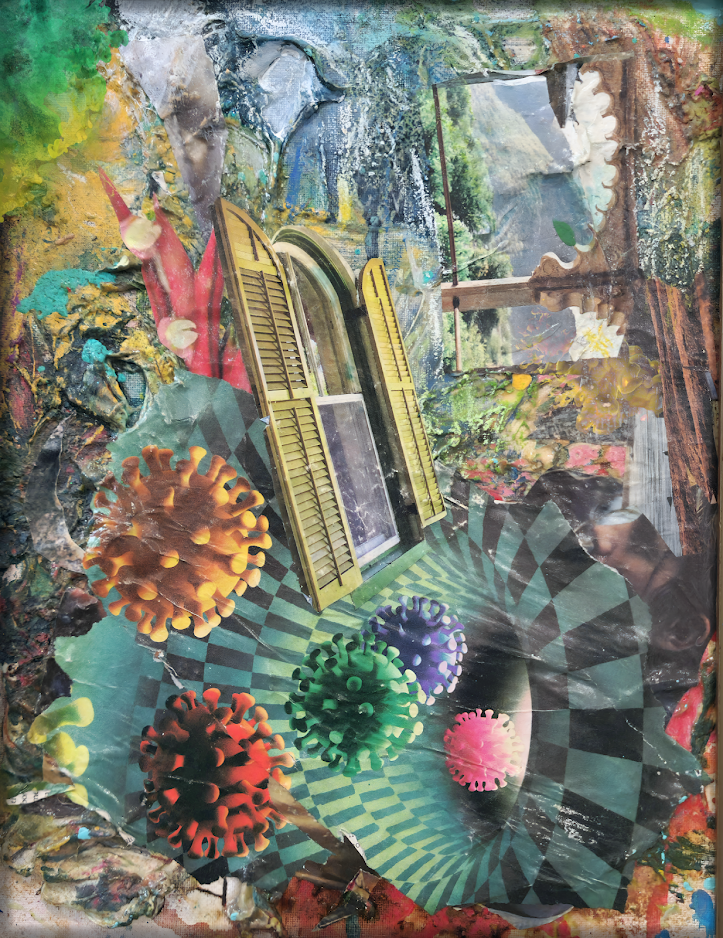
In Megan Ashman’s work, a realm is rarely just a landscape, and a portal is rarely just a door. These spaces behave according to dream logic: walls remember, windows breathe, rooms hold emotional weather, and distance becomes unstable. A doorway may lead inward instead of forward. A staircase may rise into memory. A cave may become the mouth of the subconscious. The painting does not ask the viewer to stand outside and understand it. It asks the viewer to cross over.
This is where the visible world begins to thin. Not disappear — thin. Reality becomes permeable, layered, negotiable. What looks like architecture may be a psychological structure. What looks like a landscape may be a state of mind. What looks like a beautiful impossible opening may be the exact place where the self begins to change.

The idea of the portal runs through Ashman’s mixed-media practice because her paintings are built as thresholds themselves. Paint, paper, photographs, found objects, metallic pigments, inks, fabric, texture, and chance do not simply decorate the surface. They create passage. Each layer becomes another atmosphere the viewer must move through. Each hidden image becomes a door left slightly open.
This is the foundation of Phantasmagorism: a shifting visual world where images appear, disappear, and return differently with time. From far away, the painting may first behave as abstraction — color, movement, atmosphere, composition. But closer looking changes the terms. Faces surface. Animals emerge. Hands, eyes, figures, dwellings, landscapes, symbols, and fragments begin to gather themselves from the field. The whole and the parts do not tell the same story. Gestalt becomes part of the spell: the image is more than what was placed there, more than what the artist consciously arranged, more than what the viewer first thought they saw.
This is also where dissociation becomes part of the creative language. Ashman’s process is not purely intellectual or planned; it is subconscious-driven, often entered through a trance-like state where ordinary reality falls away and the image begins to form from somewhere deeper than conscious decision. The act of painting becomes a kind of leaving — not absence, but access. A temporary crossing into the interior realm where symbols rise before they are understood, where chance begins to feel guided, and where the unseen mind gives itself a surface.
That is why portals matter here. They are not only subjects inside the paintings; they are the way the paintings function. They shift the viewer from one kind of seeing into another. They require a deeper kind of looking — the kind that lets the image reveal itself at its own speed. The longer the viewer stays, the more the surface begins to reorganize itself. Not because the painting has changed, but because perception has.
A portal can be a literal doorway, but it can also be a tear in certainty. A window. A mirror. A dark passage. A circle of light. A patch of iridescent paint that suddenly feels like atmosphere. A collaged photograph that looks accidental until it becomes unavoidable.
What first appeared abstract begins to gather itself into image, symbol, memory, and message. Once seen, it cannot be unseen. The painting has not changed. The viewer’s perception has.

These realms are not fantasy in the shallow sense. They are not decorative dream worlds made only to escape the ordinary. They give the unseen a place to gather: subconscious memory, spiritual recognition, dissociation, longing, trauma, intuition, grief, wonder, and the universal suspicion that reality is not as flat as we were told.
A person enters these paintings the way one enters a dream already in progress. There may be no clear beginning, no single explanation, no tidy symbolic key. That is part of their truth. Dreams do not explain themselves politely. They compress. They rearrange. They speak through fragments because fragments are often more honest than complete narratives. A staircase, a bird, a house, a hand, a patch of dark blue, a strange glow behind a figure — each may carry meaning without surrendering all of it.
In this sense, the portal becomes both place and process. It is the opening between conscious intention and subconscious arrival. It is the space where chance begins to feel guided, where materials act like collaborators, where the painting seems to remember something the artist did not intentionally put there.
Maybe that is the deeper invitation. Not to solve the realm, but to inhabit it. Not to decide what every symbol means, but to notice what begins moving inside the viewer when the image opens. The work does not close behind us with an answer. It leaves the door ajar.