


Lobster
$925.00Price
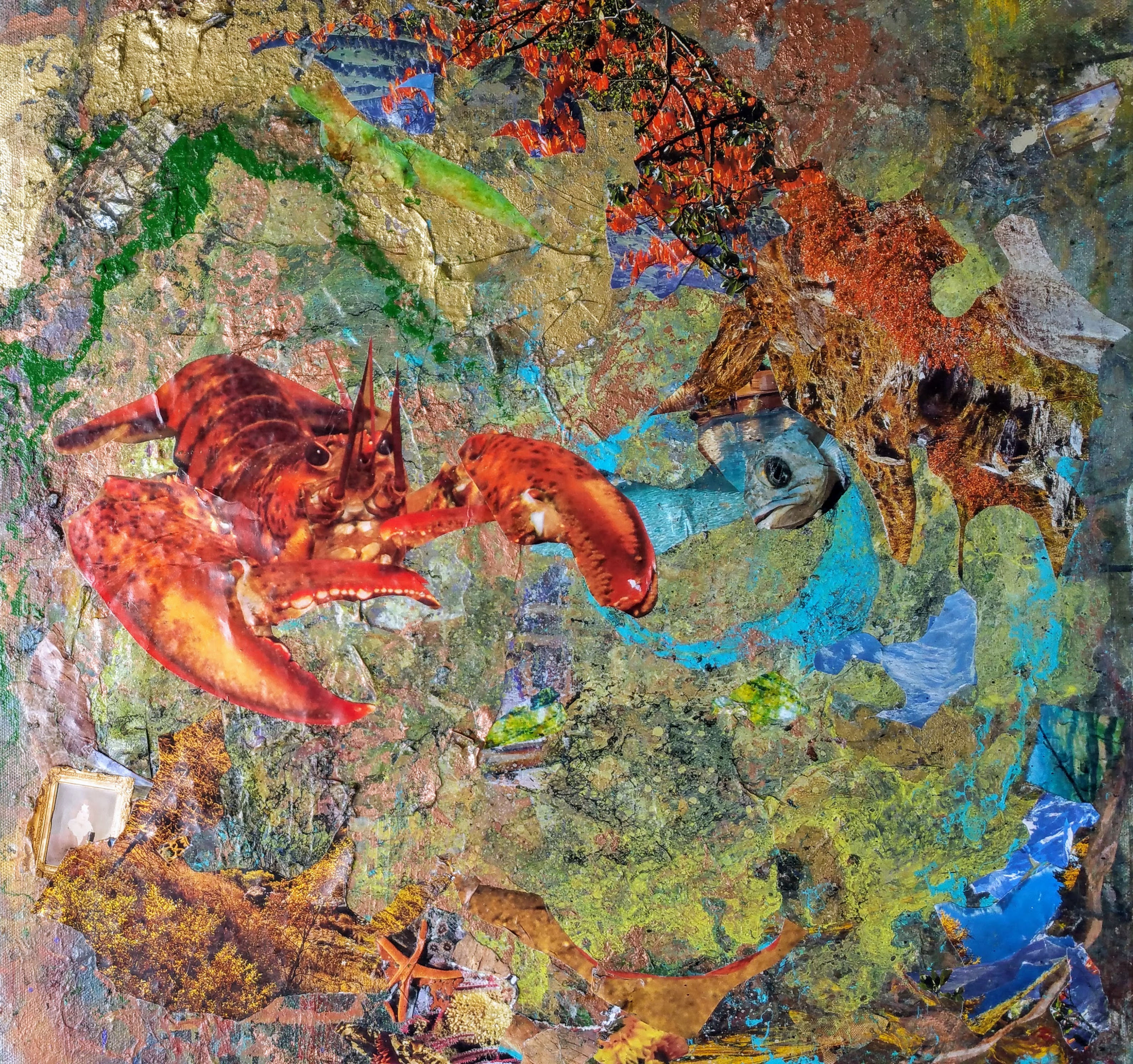
A crimson. sprawls across oxidized gold like a heraldic creature on ancient armor, its claws opened in gesture that reads as greeting or warning or simply the shape of existing while armored. The background remembers underwater archaeology—corroded metals, stone worn smooth by current, coral colonies building their calcium cities grain by grain across centuries. Fish skeletons drift like memories of meals, ecosystems, the endless cycle of consumption that ocean requires. Rust blooms like blood in water, spreading and dissipating, staining everything. The textures layer so deeply the canvas becomes reef itself, encrusted and dimensional, every surface a substrate for growth. This. occupies liminal space between still life and symbol, between specimen and totem. s can theoretically live forever, their cells capable of indefinite division, their bodies growing larger through successive molts until size itself becomes vulnerability. This creature represents endurance at cost—surviving through hardness, through building walls of chitin and calcium, through retreating into crevices and waiting. The golden-amber background suggests trapped light in deep water, sun filtered through fathoms until it becomes foreign to itself, warmth turned strange by pressure and distance. Small fragments of blue-green appear like windows to the surface world far above. The painting understands that ocean is another planet sharing our address, that creatures there evolved solutions so different from terrestrial life they might as well be alien. The. regards us with its positioned eyes, if it regards at all—we can never know what cognition happens in that ganglia-based nervous system, what it means to navigate by chemical signature and water pressure, to molt your entire self and emerge soft and vulnerable before hardening again into fortress.
Details
An original mixed media artwork, rich with surreal symbolism and tactile intrigue.. Each layer is meticulously built upon a heavy-duty stretched canvas using a myriad of materials, inviting the viewer into a world of texture and depth.. The included collage elements are printed with archival inks on fine art papers, ensuring the vibrancy lasts for generations.Size
24x24Materials & Techniques
mediums/materials: phosphorescent paints, found objects, paper, wax, photo collage, oxidative inks, distress paint and inks, acrylic pouring, digitally altered images, acrylic paint, watercolor, spray paint, walnut ink, staining mediums, tissue paper, mica powders, glitter, heavy gel medium, gesso, pebeo prism and fantasy paints, ceramic paint, stained glass paint, alcohol inks, iridescent inks, distress crayons, charcoal, pastels, oil pastels, string, beads, jewelry, gems, chains, buttons, foils, newspaper, vinyl, plastic, walnut inks, india ink, colorshift paints and more!Hidden Images & Elements
The lobster's crimson coloration is actually caused by cooking—living lobsters are typically greenish-brown, only turning red when heat denatures their shell proteins.. This painting's bright red lobster is therefore already transformed, already subjected to fire, suggesting themes of trial by ordeal, transformation through suffering, or death made decorative.. The positioning with open claws creates a heraldic quality, reminiscent of coats of arms where creatures are displayed in formal poses representing family virtues.. What virtue does the lobster embody?. Defense, perhaps.. Persistence.. The ability to survive in hostile environments through sheer armoring.. The fish skeleton represents prey, ecosystem dynamics, the endless feeding that sustains ocean life.. It also suggests memento mori—death as structure, what remains when soft tissue fails.. The oxidized golden background evokes both sunken treasure and the color of deep water when light barely penetrates.. It suggests archaeological sites, shipwrecks colonized by marine life, how ocean claims human artifacts and transforms them into habitat.. The coral-like formations in rust-orange reference reef building—how living creatures create geological structures, how biology becomes mineral, how countless small lives accumulate into underwater mountains.. The blue-green fragments function as windows to the surface, reminders of the air world above, or perhaps they're bioluminescent organisms—ocean creates its own light in the depths where sun cannot reach.. The heavy texture mimics encrustation, the way underwater surfaces attract barnacles, algae, sediment, becoming rough and layered with competing life forms all seeking substrate.. ```Interpretation
This work contemplates survival strategies based on hardness versus softness, armor versus vulnerability.. The lobster represents one extreme evolutionary solution: build impenetrable walls, retreat into shells, grow weapons for defense and feeding.. Yet this hardness comes with costs—the periodic necessity of molting, those terrible vulnerable hours when the creature emerges soft and defenseless, must hide and wait for the new shell to harden.. The painting asks what we armor against and what we lose in the armoring.. The oxidized, archaeological quality suggests deep time—ocean operates on scales that dwarf human lifespans.. Lobsters can live over a hundred years, growing continuously, their bodies potentially immortal if not for predation, disease, or the increasing difficulty of molting as they grow larger.. They represent a kind of biological immortality that's also a trap: live long enough and your own success becomes your vulnerability, you grow too large to hide, too old to molt successfully.. The collision of vibrant red against weathered gold creates tension between vitality and decay, between the fresh kill and the ancient substrate.. Everything in ocean is simultaneously feeding and being fed upon, building and being eroded.. The fish skeleton reminds us that the lobster is predator but also prey, that armor only protects until it doesn't.. The piece explores how we construct protective identities, hard shells of personality or belief that keep the soft interior safe.. But like the lobster, we must occasionally shed these protections to grow, emerging vulnerable and new before hardening again into slightly larger versions of our defended selves.. The painting offers no judgment about whether this is wise or tragic—it simply observes the pattern, notes the cost, honors the endurance.. ```Poetry
